
Faster Compliance, Stronger Networks: How Technology Is Redefining OEM Audit Efficiency

For decades, OEM collision repair compliance audits have followed a well-established format. Auditors conducted time-intensive on-site inspections to validate adherence to OEM operating standards – reviewing facilities, tooling, equipment, and technician training. While effective, this approach was inherently slow, resource-heavy, and difficult to scale across large or geographically dispersed repair networks.
Compliance has always been the foundation of OEM certification programs. What has changed is the efficiency with which that compliance can now be verified.
Technology Designed to Support Auditors, Not Replace Them
A new generation of SaaS audit platforms – augmented by Artificial Intelligence – is transforming how compliance audits are delivered. Importantly, these platforms are not designed to replace auditors or their professional judgement. Instead, they are built to support auditors by removing administrative burden, accelerating evidence review, and allowing auditors to focus on higher-value decision-making.
AI plays a similar role. It assists with consistency, pattern recognition, and speed, but the auditor remains firmly in control – interpreting findings, validating outcomes, and engaging directly with repair partners. The result is not automation for its own sake, but a smarter, more efficient audit process that amplifies human expertise.
A Step-Change in Audit Speed Enabled by Technology
Modern audit platforms now enable compliance evidence to be captured digitally, reviewed remotely, and validated in advance of a site visit. AI helps pre-screen submissions, highlight gaps, and flag anomalies, significantly reducing the amount of time auditors must spend on manual verification during on-site visits.
The impact on audit duration is substantial.
The impact of this shift is clear when comparing audit time allocation over recent years:
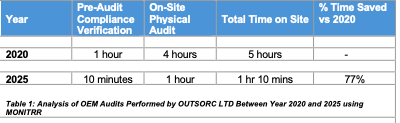
Analysis of OEM Audits Performed by OUTSORC LTD Between Year 2020 and 2025 using MONITRR
This 77% reduction in total on-site audit time represents a fundamental improvement in efficiency. Crucially, it is achieved without reducing audit scope or lowering standards.
More Efficient Auditors, Better-Controlled Networks
By combining digital workflows with AI-assisted review, auditors can work more efficiently while maintaining strong governance and consistency. Standards are applied objectively, documentation is reviewed more quickly, and issues are identified earlier, often before an on-site visit.
For auditors, this means:
Less time spent on repetitive, manual checks.
More time is devoted to key issues rather than minutiae.
More time focused on professional judgement and engagement.
Reduced travel and on-site administration.
The ability to complete more audits without increasing workload.
For OEMs, it means compliance programs that scale without a proportional increase in cost or headcount.
From Audit Bottleneck to Operational Advantage
Speed matters. Faster compliance audits enable quicker shop onboarding, reduced disruption to repairers, and more agile network management. Certification decisions can be made sooner, corrective actions can be tracked more efficiently, and compliance data can be kept continuously current rather than reviewed infrequently.
This is not about doing less compliance. It is about doing the same compliance checks more intelligently, using technology to remove friction while preserving the auditor’s central role.
The Future of OEM Compliance Audits
As OEM collision repair networks grow and vehicle complexity continues to increase, legacy audit models struggle to keep pace. Manual, on-site-first audits create bottlenecks that limit scalability and consume valuable auditor capacity.
Modern SaaS platforms and AI are no longer optional enhancements. They are essential tools for OEMs that want faster audits, stronger governance, and better use of their audit teams’ expertise.
The future of compliance auditing is not auditor-free. It is auditor-enabled - powered by technology that improves efficiency, consistency, and scale, while keeping human judgement exactly where it belongs: at the centre of the audit.